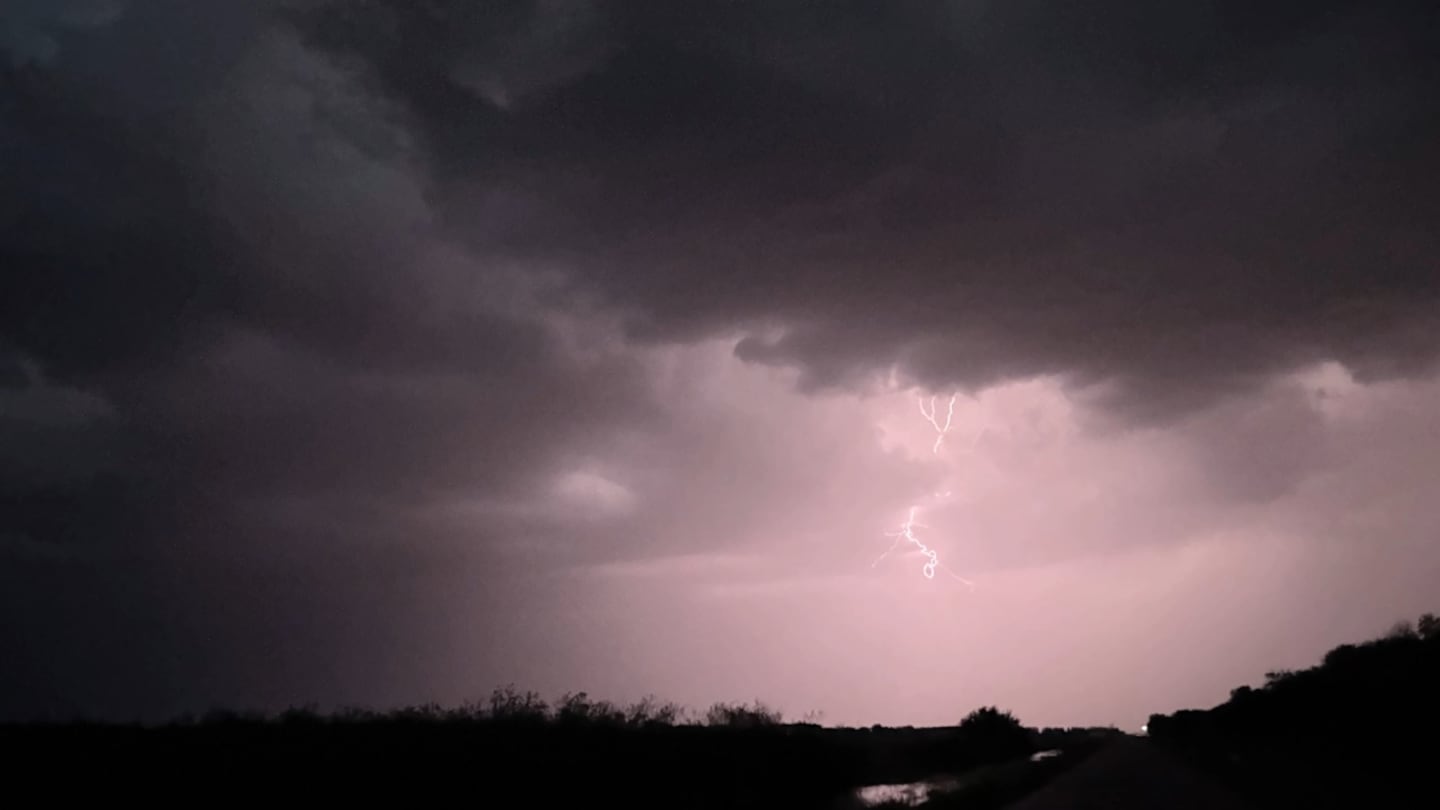
Cleanup efforts continue following a series of severe thunderstorms which rolled through Saskatchewan’s southeast and east central regions over the weekend causing heavy rainfall, damaging winds and golf ball-sized hail. Sunday night saw localized flooding caused by intense rainfall in addition to four reports of funnel clouds in the region. Barricades for a few main roads in the town of Kipling were in place on Monday as the town recovered from the violent Sunday storm. “We’ve just got more water than we can deal with,” Mayor Pat Jackson told CTV News. Town employees, volunteers and local businesses spent the day pumping water from the inside of their homes and buildings. “If we’ve got the equipment to do it, we do it. I know that G.B. construction, who’s one of our biggest employers in the community, they’re going not just here, but in other location,” Jackson said. “They have six, I believe, shops and so they’re busy helping out wherever they can, plus trying to do the work that they have contracted to do for the summer.” Braydon Morisseau, a storm chaser from Cochrane, Alta. drove throughout southeast Saskatchewan Sunday night after hearing about the possibility of multiple tornado warnings. “We were chasing down by Carlyle. We had a storm go up along the front and fortunately, the storm fell apart. Otherwise, it would have been quite a dangerous day,” Morisseau said. “We continued further into southeast Saskatchewan, down by Carnduff, where we believe was a QLCS tornado or an embedded tornado in that big line of storms that pushed through.” As of Monday evening, there have been no confirmed reports of tornadoes, according to Environment and Climate Change Canada (ECCC). However, Morisseau said significant damage still occurred because of the storms. “We’re seeing a lot of wind damage from the line of storms that kind of pushed through later, that created a lot of strong winds, some hail, lots of trees down, grain bins,” he said, also referring to the storm damaging the Co-op Cardlock in Carlyle. Matt Loney, a meteorologist with ECCC, explained the inner workings of the dangerous storms. “The ingredients for a severe thunderstorm really originate with a contrast in air masses. You got the cold air to the west which we have in Alberta and B.C., and the warm air which was in place over the east which actually came from the southern U.S. through [a] moist and humid air mass which made its way to the north,” he said. “Then we had wind shear in place. We had a very strong river of air in the middle and upper atmosphere combined with a low-level jet stream that originated from the southeast.” The disruptive weather is expected to continue on Tuesday, Loney added. “We are looking, and potentially, there might be the need to put out some alerts tomorrow for severe weather, but we’re still in the development stages of that,” he said. “Beyond that the forecast for the rest of the week is going to be looking more stable.” Storm recapOver an 18-hour period, ending at 7 a.m. Monday, June 8, the communities of Broadview, Nipawin, Yorkton and Parr Hill received 73.5, 25.1, 22 and 30.5 millimetres (mm) of rainfall respectively. Duck Mountain and Torch River both received 43.7 mm over the same period. Over a 24-hour period ending at 8 a.m. Monday, Bredenbury and Maryfield reported 55.9, and 20.3 mm of rainfall. Strong wind gusts were reported in Estevan and Moose Mountain Park with 111 and 91 km/h – while Leader reported a maximum speed of 89 km/h. Finally, the communities of Antler and Balgonie reported golf ball sized hail while MacNutt reported toonie sized hail.
|